Table of Contents
ToggleI still remember the first clip that changed my blog’s traffic overnight — a messy, joyful kitchen moment that hooked viewers in seven seconds.
In this guide I lay out a clear, point-wise path. I explain the ingredient lists, compact steps, and the visual facts that make short-form clips work alongside full posts.
Expect concrete tips: watch-time drivers, irresistible shots, and simple methods readers can follow without fuss.
I’ll show filming settings, lighting tricks, and editing moves that boost momentum. I also cover modular captions and caption-first edits because many watch in silence.
Where it helps, I link practical examples like an easy casserole that adapts well for short clips and long posts: easy chicken burrito casserole.
Key Takeaways
- Use bold hooks and fast steps for short clips.
- Pair snackable video with full, clear recipe cards.
- Optimize lighting and angles for crave-worthy visuals.
- Edit for momentum: jump cuts, captions, and speed ramps.
- Repurpose clips across platforms while keeping quality.
- Include schema-ready recipe cards to turn views into readers.
Understanding TikTok’s Food Culture and Today’s Attention Dynamics
On this platform, you get one shot in a second — I use striking action to secure that look. TikTok pushes short bursts of attention, so I pair concise steps with clear sensory facts that make viewers finish a clip.
Why short, snappy videos win: watch time is king. Users decide near-instantly whether a video stays or scrolls. I lead with motion, texture, or a dramatic reveal to earn that first second.

Content formats that trend now
- I favor quick tutorials under 60 seconds and time-lapse transformations that show progress fast.
- ASMR-style sizzles and close-ups of stretch, crunch, and steam trigger sensory curiosity.
- Challenges and remixable clips invite duet and stitch, so I keep steps modular and ingredients simple.
- I layer human presence — on-camera smiles or short voiceover lines — to deepen connection and raise retention.
Finally, I treat every upload as an experiment. I track retention graphs and tweak pacing, step order, and hooks where attention drops. This keeps my content aligned with platform trends and audience behavior.
How to Create Viral TikTok Food Recipes for Your Blog
My workflow pairs a bold visual hook with short, numbered steps that keep viewers watching. I use a clear five-part process so each clip funnels curious people back to the full recipe on my site.
My five-part framework
- Hook — show the payoff first: glossy cheese pull or crisp flip.
- Steps — tight, numbered cuts; each step lasts 1–2 seconds.
- Payoff — a clean reveal that rewards watching.
- Loop — end on the opening action to encourage rewatches.
- CTA — short, direct: “Save this; full recipe on my blog.”
Three quick recipe blueprints
- 5-Minute Garlic Butter Pasta — ingredients: spaghetti, butter, garlic, red pepper flakes, parsley, parmesan, salt.
- Boil pasta.
- Sizzle butter + garlic.
- Toss pasta; finish with flakes, parsley, parm.
- Fork-twist reveal.
Fact: glossy sauce and cheese strands lift retention.
- 3-Ingredient Baked Feta Dip — ingredients: feta block, cherry tomatoes, olive oil.
- Oil dish; add tomatoes + feta.
- Roast, then smash and swirl.
- Scoop with bread.
Fact: firm-to-creamy change creates a clear narrative arc.
- Crispy Potato Wedges — ingredients: russet potatoes, olive oil, parmesan, spices.
- Cut, season, bake, flip, crunch-test close-up.
Fact: audible crunch and steam trigger ASMR-style engagement.
Quick facts that boost shareability
- I appear briefly for personality, then let the dish dominate.
- Layer an emotional hook — “weeknight lifesaver” — for saves and shares.
- Tag one trending sound and a clean version to ride discovery while staying cross-platform friendly.
Pro tip: keep each step tight, slow down at the transformation, and end with a clear CTA that sends readers to the full recipes.
Filming Like a Pro on a Phone: Camera, Lighting, Angles, and Setup
A neat setup and a few phone tweaks make every clip look expensive without expensive gear.
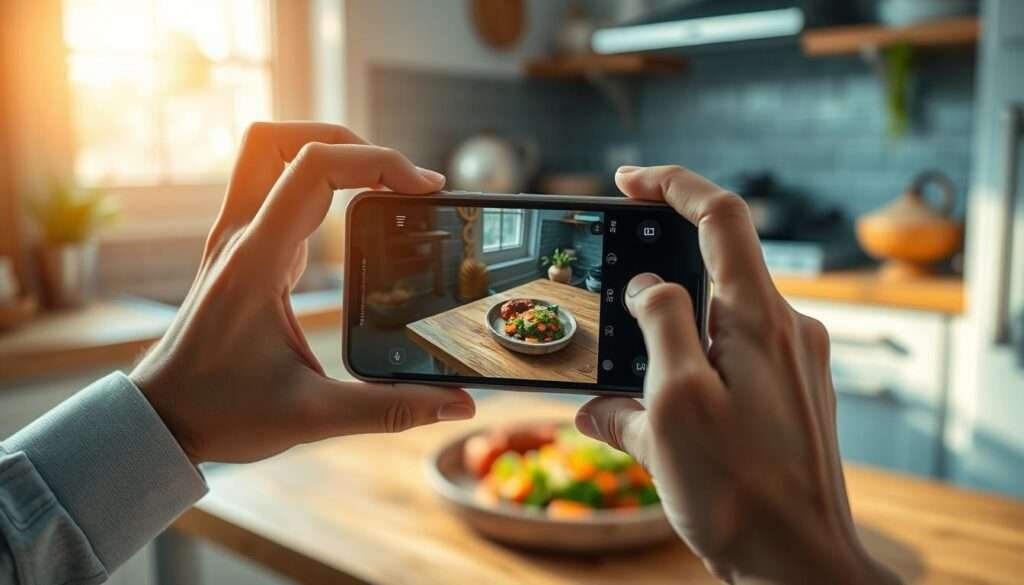
I set my phone to 4K/60fps when storage allows, or 1080p/60fps if space is tight. I always wipe the lens—tiny smudges mute texture and color. Then I lock focus and exposure on the dish and nudge exposure slightly higher so oils and glazes catch the light.
The quickest light win is a window with diffused sun. If I film at night, I use a softbox or ring light and avoid yellow overheads that dull greens and warm tones.
Essential angles and stability
I rotate three reliable shots: top-down for assembly, 45-degree for plated depth, and macro for cheese pulls or crust texture. I mount the phone on a tripod with a clamp and use a remote shutter so pours and flips stay clean.
Workflow tips that save time
- Pre-measure ingredients in clear bowls for fast swaps between takes.
- Keep backgrounds neutral—light wood, marble, or linen—to maintain a consistent style across uploads.
- Plan a short shot list: hook, key steps, transformation, final plate; this keeps run time tight and intentional.
- Record three-second safety clips for each action so editing feels flexible and fast.
| Setting | Why it matters | Quick tip |
|---|---|---|
| Resolution & FPS | Captures texture and motion clearly | Use 4K/60fps or 1080p/60fps |
| Lighting | Defines color and appeal | Prefer natural; softbox if needed; avoid yellow lights |
| Angles | Shows process and payoff | Mix top-down, 45°, and macro |
| Stability & Workflow | Keeps motion smooth and takes efficient | Use tripod, remote, and prepped bowls |
Practical note: if you want a quick checklist or answers about gear and settings, see the FAQ page.
Editing for Maximum Engagement: Pacing, Color, Text, and Loops
Great edits turn a few raw takes into a tempting, snackable clip viewers rewatch. I keep the edit lean and deliberate so the final content earns attention in the first few seconds.

Cutting with purpose
I cut from action to action—no preamble—and use jump cuts to remove pauses that hurt retention. I slow only the hero moment (pour, flip, cheese pull) to 0.5x for about two seconds, then snap back to normal.
Color and texture
I bump warmth and lift saturation in reds and yellows to make sear and cheese pop. I push contrast for baked textures so crust and crumb read at a glance.
On-screen clarity
I add text overlays for teaspoons, temps, and bake times so viewers can follow without sound. I enable auto captions, correct typos, and align lines with the on-screen action.
Tools and final checks
I edit speed ramps and transitions in CapCut, trim in VN, and finish music and text polish in InShot. I watch the exported video at 1.25x—if it stays snappy, the process worked.
“Cut fast, grade with care, and loop the payoff.”
Audio, Hashtags, and Trends: How I Get Discovered Fast
Sound choices and smart tags are often the reason a short clip finds new eyes fast. I treat audio, tags, and trend research as a single publishing step that guides discovery and boosts engagement.
Sound layering is my first edit. I record a clean voiceover in a dampened box, then place natural sizzles above it and a low-volume music bed under both. I set music 20–30% below voice so instructions stay clear while clips feel energetic.

Syncing beats and reveals
I map beats to actions: a pan flip lands on a beat drop and a cheese pull hits the chorus. That rhythm raises completion rates and encourages rewatches. I keep one trending sound and one evergreen version so the clip works on the platform and across other social media.
Hashtag stack and trend tools
My tag formula: two broad hashtags, two niche tags, and one challenge tag when relevant. I check TikTok’s Creative Center weekly to spot trending sounds and emerging trends, then adapt concepts with those cues.
Engagement tactics that scale
- I ask short questions like “crispy or chewy?” and run polls to spark replies.
- I answer hot questions with pinned video replies; users reward that with saves and follows.
- I keep a notes doc of favorite sound cues and hashtag sets to speed publishing on busy days.
Quick fact: pairing natural cooking sounds with a mapped beat and a tight hashtag stack increases discovery and keeps your audience coming back.
From TikTok to Blog: Turning Views into Readers with WP Recipe Maker
My blog is where a curious viewer becomes a loyal reader after a single short clip nudges them over.
I post short clips that tease the payoff, then send visitors to the full recipe on my site. The blog acts as the hub for measurements, timing, and notes.
How I publish:
- I build recipe cards with WP Recipe Maker that mirror my clip style—fonts, colors, and imagery—so the jump feels seamless.
- I embed the vertical clip at the top of each post so readers can watch without leaving the page.
- WP Recipe Maker adds schema for rich results: ratings, times, and ingredient lists display in search.
Collections and monetization
- I group posts into collections like “Weeknight 20 Minutes” and use WP Ultimate Post Grid for quick filtering.
- I add honest affiliate links for tools and pans I use. This keeps monetization natural.
Pro tip: keep the Print view tidy and a visible Pin Recipe button to boost saves and recirculation.
| Feature | Benefit | Tool |
|---|---|---|
| Custom recipe cards | Consistent brand across media platforms | WP Recipe Maker |
| Filtering grids | Faster discovery for readers | WP Ultimate Post Grid |
| Schema & sharing | Better search visibility and social shares | Built-in recipe maker schema |
Posting, Engagement, and Brand Building Across Platforms
A single strong moment in the opening seconds often decides whether someone follows or scrolls.
The first three seconds: I open with a bold claim or a visual—gooey pull, sizzling pour, or a quick line like “3-ingredient dinner in 10 minutes.” This stops the scroll and sets clear expectations.

The modular play
I plan short, reusable clips so the same core content works across platforms without full re-edits. I export vertical, square, and trimmed versions to fit Reels, Shorts, and Idea Pins.
Community playbook
I batch-caption prompts—“Team crispy or soft?”—and pin them to spark comments and saves. I treat comments as content fuel: quick replies, video responses to popular asks, and highlight remakes in stories.
Creator identity
I keep a consistent brand voice—friendly, quick, practical—with signature moves like macro crunch tests and a short sign-off line. This helps followers recognize me wherever they discover my clips.
“Make your profile, bio link, and thumbnails cohesive so readers connect the clip back to the blog.”
I schedule posts with a simple calendar: 3–5 shortform pieces weekly, 1–2 blog posts, and daily micro-engagement. For branding and growth best practices, see a practical guide on food blog branding.
Conclusion
Finish strong: use shortform wins as a bridge back to reliable, searchable posts. My playbook turns attention into action: grab interest fast on the platform, then guide the audience to the full recipe on the blog for complete ingredients and clear steps.
I rely on simple tools and a consistent style so making easy, high-quality videos becomes a repeatable habit. WP Recipe Maker keeps recipe cards organized, adds schema for search, and aligns the post with my short clips for smooth sharing across media platforms.
Quick takeaways: sharp hooks, tight edits, clear on-screen instructions, synced reveals, and a CTA that sends users to a single blog post where I display recipes and measurements.
Try this next: plan the shot, film the transformation, add captions, pick smart hashtags, publish, then analyze viewers’ behavior and iterate. See a practical example and method for baking and sharing a crisp dish at crispy baked falafel.